


.svg)
.svg)
.svg)
.svg)
.svg)
.svg)
.svg)
.svg)
.svg)
.svg)
.svg)
.svg)
.svg)
.svg)
.svg)
.svg)
.svg)
.svg)
.svg)
.svg)
.svg)
.svg)

In healthcare, the riskiest AI is often the kind nobody signed off on.
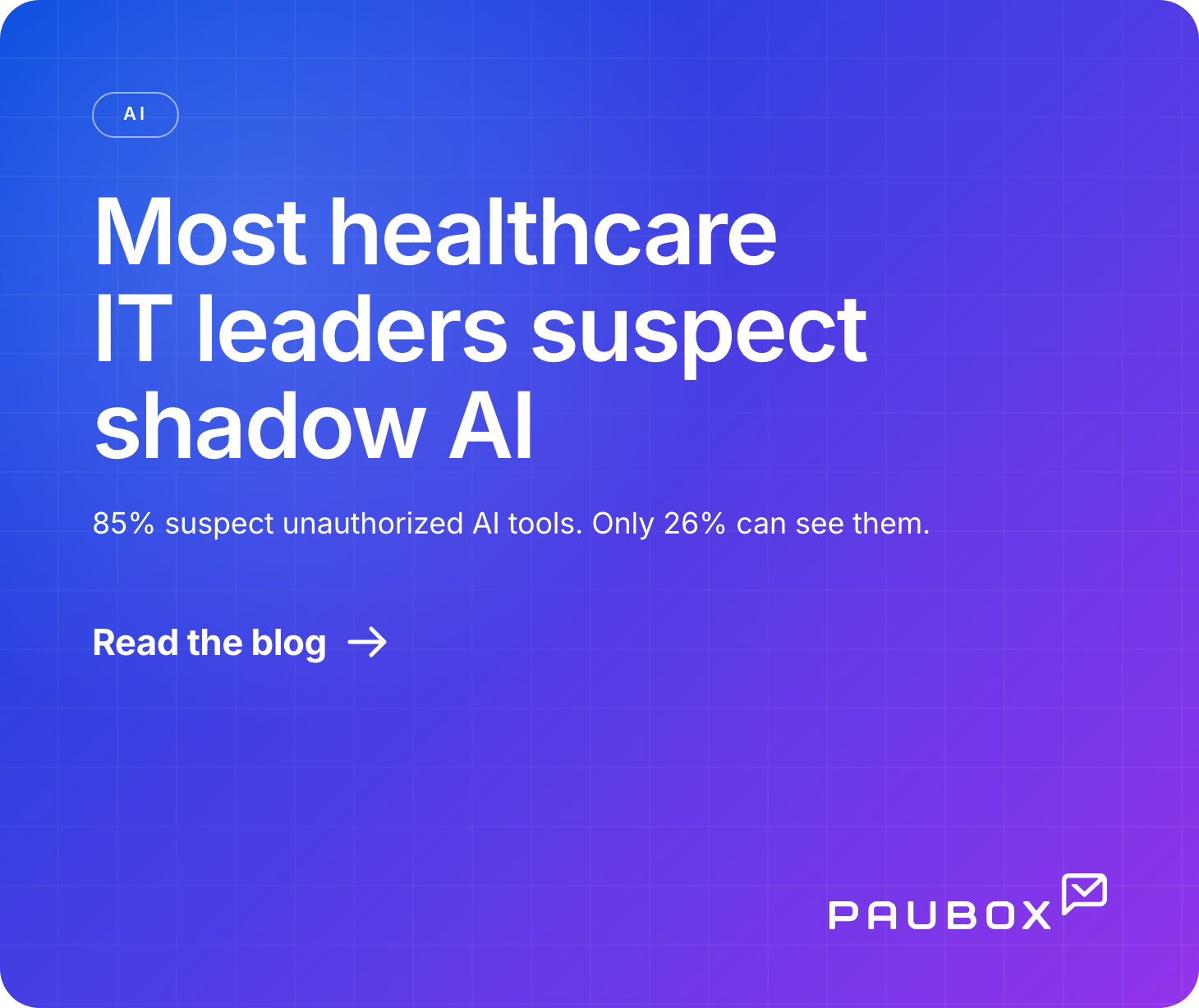
In Paubox's 2025 research, 85% of healthcare IT leaders suspected staff were using unauthorized AI tools, and only 26% had real visibility into that use. More than two-thirds had already found unsanctioned AI somewhere in their organization. The tools are in the building. The open question is whether protected health information (PHI) is going into them safely, or into a consumer chatbot with no business associate agreement (BAA) and no encryption behind it.
When the activity can be measured, the scale is striking. In one healthcare customer environment, Menlo Security observed 276,000 file uploads to generative AI tools in a single 30-day period, most with no policy, no visibility, and no governance behind them. That is the distance between suspicion and reality: the exposure is not hypothetical, it is just unseen.
That is shadow AI: staff using AI tools that IT never reviewed or approved. In most healthcare organizations it is already happening, and a policy that says "do not" can't stop it.
What shadow AI looks like in healthcare
Shadow AI usually looks mundane: people trying to get their work done a little faster.
A nurse pastes a patient's history into a personal chatbot account to draft a discharge summary. A biller drops an explanation-of-benefits into a free tool to reword it for a patient. A clinician uploads a chart to summarize it before rounds. Each of them is moving PHI to a vendor that may have never signed a BAA, and often to a consumer tier that trains on the input and lets human reviewers read it.
None of it shows up in your system logs, because it never went through a system you control.
Why staff reach for unsanctioned tools
People use shadow AI because it is faster than the approved way, and often because there is no approved way at all.
When the sanctioned workflow is slower than pasting text into a chatbot, the chatbot wins. Training will not fix that, because it is really a product problem. The compliant path has to be at least as easy as the shortcut, or people route around it.
Why a ban makes it worse
The instinct is to prohibit consumer AI outright. In practice, a ban drives the behavior underground without ending it.
Staff who were pasting notes into a browser tab do not stop needing to draft summaries faster. They just stop telling anyone how they do it, which takes the little visibility you had and drops it to zero. You are left with the same PHI exposure and a smaller chance of ever seeing it.
Give people a compliant path that beats the shortcut
The move that actually reduces shadow AI is to make the sanctioned option the easy one.
Approve specific tools that will sign a BAA and meet your security bar, and put them where staff already work. If people need to summarize charts, give them a HIPAA compliant assistant that does it. For patient intake, a compliant tool like Paubox Forms keeps data out of consumer apps. The point is to make the compliant path the path of least resistance, so no one has to choose between doing their job and doing it safely.
For the full picture of standing up AI on PHI the right way, from choosing a model to sending the result, see our guide to building with AI in healthcare.
Get visibility before you need it
You cannot govern what you have never catalogued. Building an inventory of which AI tools are in use, and which touch PHI, turns shadow AI from a rumor into a list you can act on.
The Health Sector Coordinating Council's AI Cybersecurity Governance Framework Implementation Guide includes practical inventory and vendor contract-language tools for exactly this. Pair that inventory with a simple standing question for any new tool: will the vendor sign a BAA for how we intend to use it? If the answer is no, it does not get PHI.
Start here
Shadow AI is worth reading as a signal. It shows you where staff need AI and where your compliant options are too slow.
Meet that demand with sanctioned, BAA-backed tools that are easier to use than the workarounds, build an inventory so you can see what is actually running, and give every PHI-carrying step a compliant channel. Do that, and the AI already in your building stops being a liability you cannot see.
Related: Watch our on-demand webinar on the HIPAA Security Rule changes.
